Vertical Growing on a Small Balcony
How to grow upwards on a small balcony: trellises for climbing crops, wall planters, tiered stands, and the weight, wind and watering limits.
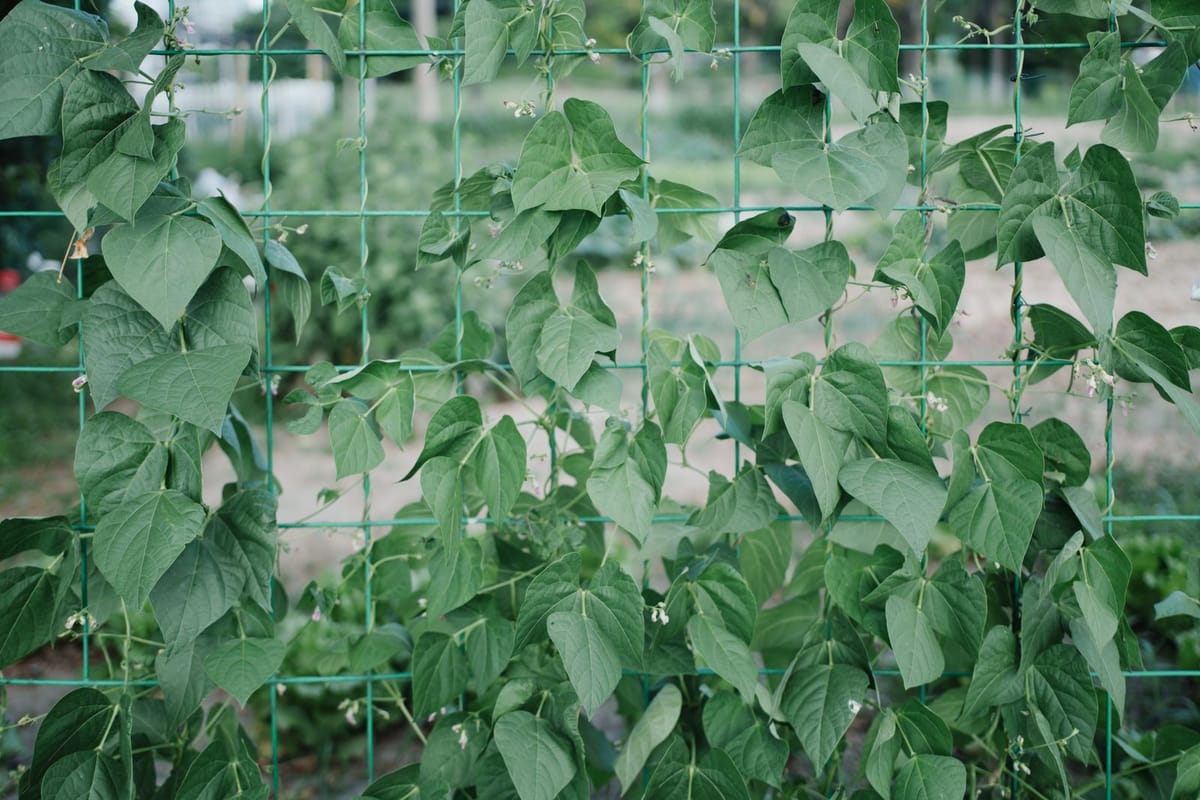
A balcony's floor is the scarcest thing on it. Once a couple of pots and a chair are down there is rarely room for more, which is why the useful question is not what else fits on the floor, but what can go up the wall or the railing.
Vertical growing is not one technique. It covers training climbing crops up a support, hanging planters on a wall, and simply stacking pots on a tiered stand. They suit different crops, they suit different balconies, and they fail in different ways.
Why grow upwards on a balcony?
Two reasons, and only one of them is space.
The obvious one is footprint. A pot of climbing beans takes up the same floor area as a pot of lettuce but crops over a far taller volume. On a balcony measured in single square metres, that ratio is the whole argument.
The less obvious one is light. Balconies are often shaded at floor level by the railing, the balcony above or the building itself, while the air a metre higher is noticeably brighter. Lifting plants up can move them into usable light, which matters most if you are working with a north-facing balcony or any space that only gets a few hours of sun.
Which crops climb a balcony trellis best?
A trellis is the highest-yield vertical option because it uses the crop's own climbing habit. A deep pot at the base, a support behind it, and the plant does the work.
Crops that climb willingly include runner beans and climbing French beans, peas and mangetout, cucumbers and the smaller squashes, and cordon (single-stem) tomatoes trained up a cane or a string.
Two things decide whether it works. The pot has to be big enough, because a plant climbing two metres needs a root volume to match, and the support has to be fixed to something rather than leaning against it. A trellis loaded with beans in a gust is a sail.
Do wall planters work on a balcony?
Wall planters, whether rigid troughs, felt pockets or a modular green wall system, put shallow-rooted crops at eye level and use a surface that was otherwise doing nothing.
They suit cut-and-come-again salads, most herbs, strawberries and chard. They do not suit anything needing depth or a steady water supply, because the defining problem of a wall planter is how fast it dries out. A small volume of compost, airflow on every side and often full afternoon sun add up to daily watering in summer.
Felt pockets dry fastest. Rigid troughs with a built-in reservoir are the most forgiving.
Are tiered stands or stacked pots better?
The cheapest and least committal option: a freestanding tiered stand, a stepped plant ladder, or stacking planters that build height on a single footprint.
The trap is self-shading. Each tier shades the one below, so a stand placed against a wall with the sun in front of it turns its lower shelves into deep shade. Put shade-tolerant crops such as salads, parsley and mint low down and sun-lovers on top, or angle the stand so light reaches across it rather than straight down.
Stacking planters have a second quirk: water poured in at the top drains through every layer, so the bottom pot stays wettest and the top one dries first. Plant accordingly.
How do you grow vertically without drilling?
Most tenancies rule out drilling into external walls, which removes fixed wall planters and most trellis brackets. What still works:
- Freestanding trellis planters, where the support is built into a weighted pot, so nothing touches the wall.
- Railing planters that hook over the balustrade and sit on the inside face. Check they cannot be lifted off by wind, and that your building allows them.
- Tiered stands and plant ladders, which lean or stand free.
- Tension rods braced between floor and ceiling on a covered balcony, giving a vertical line for lightweight pockets.
- Over-rail and over-door hooks for small hanging pots.
The compromise is that nothing unfixed can be tall and heavy at the same time. Renter-friendly usually means lower and wider than a drilled wall system.
How often do you water a vertical set-up?
Vertical growing turns watering from a weekly chore into a daily one, and it is the reason a lot of balcony walls are bare again by August. Small volumes of compost, exposed on several sides, dry far faster than a pot sitting on the floor.
Three things reduce the load: use the largest containers the fixing will safely take, mix in water-retaining compost or add a mulch layer, and group planters so a single pass waters them all. If you are away regularly, automated watering stops being a luxury, which is covered in smart watering for a balcony on holiday.