Soil Moisture Sensors for Pots: Do You Need One?
Why pots dry out unevenly, what soil moisture readings actually mean, and when a sensor beats the finger test for container growing in the UK.
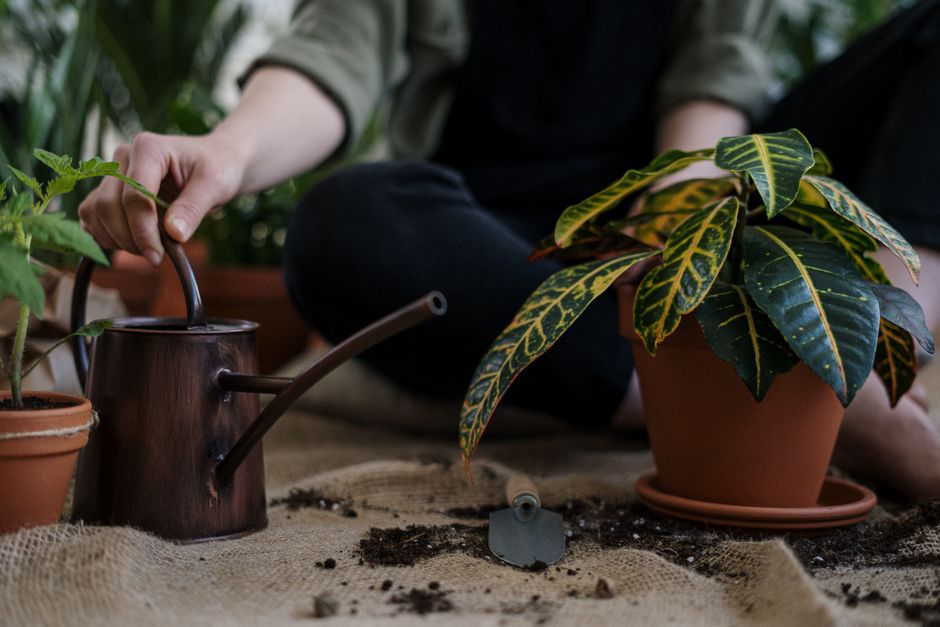
Two pots sit side by side on the same balcony, filled from the same bag of compost and watered from the same can. One is bone dry by Friday. The other is still heavy on Sunday. Nothing has gone wrong - that difference is the normal behaviour of plants in containers, and it is the single thing that makes watering by schedule fail.
Monitoring is how you replace the schedule with something that reflects what the pots are actually doing. That can mean a probe and an app, or it can mean a finger and a habit. Both are legitimate, and the choice depends less on the technology than on how often you are physically present.
Why do pots dry out so unevenly?
A container holds a fixed, small reserve of water and nothing underneath it to draw on. A plant in open ground can send roots sideways and down when the surface dries; the same plant in a 20 cm pot cannot. Once that reserve is gone, it is gone.
How fast it goes is driven mostly by evapotranspiration (the combined loss of water evaporating from the compost surface and transpiring out through the leaves). Both halves rise with heat, light and especially wind, which is why a balcony is harsher than a sheltered garden at the same temperature. An exposed corner can dry a pot in a day that would last three days two metres away against the wall.
Four things then vary that rate from pot to pot:
- Size. Small pots have less reserve and more surface area relative to volume, so they dry fastest. Anything under about 15 cm across needs checking daily in summer.
- Material. Unglazed terracotta breathes and loses water through the pot wall itself. Plastic and glazed ceramic do not. A terracotta pot and a plastic one, filled and watered identically, are on completely different clocks.
- Root density. A pot that is full of roots holds less compost, and therefore less water, than it did in spring. A plant that needed watering twice a week in May can need it daily by August without anything else changing.
- Position. Sun and wind exposure on a balcony varies over a couple of metres. This is the same reason plant choice is exposure-led - see what to grow on a north-facing balcony.
There is also a quirk of containers worth knowing. Water does not drain freely out of the bottom of a pot the way it drains through open soil. A saturated layer persists at the base - the perched water table - which is why a pot can read damp low down while the root zone in the middle has already dried out. It is also why crocks or gravel in the base do not improve drainage, despite the persistence of that advice.
What do soil moisture readings actually mean?
Most sensors report a percentage, and most people read that percentage as "percent full". It is not. What the better sensors estimate is volumetric water content (VWC - the proportion of the compost's total volume that is water). A reading of 30% VWC means 30% of that volume is water, not that the pot is 30% of the way to needing a drink.
The number that matters sits above it: field capacity (the water a growing medium retains after free drainage has stopped, usually a day after a thorough soak). Field capacity is the practical ceiling. The floor is the point where roots can no longer pull water out, and plants wilt. Useful watering happens between those two, and both depend entirely on the medium - a peat-free multipurpose compost, a loam-based mix and a coir blend all sit at different numbers.
This is the part that trips people up. Sensors are calibrated against mineral soil, not the bark-and-coir mixes most bagged compost now uses. An absolute reading of "35%" is close to meaningless across two different pots. What is genuinely useful is the shape of the reading over time in one pot: the sharp vertical jump when you water, the slope as it dries, and the level at which that specific plant starts to sulk. Watch a pot for a fortnight and you learn its personal number. That number does not transfer.
The hardware splits two ways, and the distinction is worth more than the price difference:
- Resistive probes pass a current between two exposed metal prongs and infer moisture from conductivity. They are cheap, they drift as fertiliser salts build up, and the prongs corrode - often within a season if left in permanently.
- Capacitance sensors measure the compost's dielectric property through a sealed body with no exposed metal. They cost more, hold calibration far better, and survive being left in a pot outdoors. Nearly all sensors worth wiring into a monitoring setup are capacitance types.
How accurate is the finger test?
Better than its reputation, and better than a badly placed cheap probe. Pushing a finger in to the second knuckle samples roughly the top 5 cm, which for most balcony containers is exactly the layer that tells you whether the plant is about to be thirsty.
Lifting the pot is better still. A container at field capacity is dramatically heavier than the same container three days later, and the difference is obvious after a week of paying attention. For pots you can physically lift, weight is the most reliable low-tech signal available, because it integrates the whole container rather than one spot.
The finger test fails in four specific situations, and these are precisely where a sensor earns its keep:
- Deep containers, where the top 5 cm dries days before the root zone does.
- Self-watering pots with a reservoir, where the compost surface tells you nothing about the reservoir level.
- Dense, root-bound pots, where compost has been displaced and the surface is misleading.
- Any pot you are not standing next to - which is the real one.
When is a sensor worth buying?
The honest answer is that a sensor solves an absence problem far more often than an accuracy problem. If you are home daily and have six pots, a probe will mostly confirm what your hand already told you. The cases where it changes an outcome:
- You travel. Knowing remotely whether the pots are holding is the difference between a holiday and a fortnight of low-grade worry. This pairs with automation rather than replacing it - see smart watering for a balcony while you are away and our Gardena AquaBloom review for the watering half.
- You have more containers than attention. Past roughly a dozen pots, checking each one by hand stops happening reliably, and the ones that get forgotten are always the same ones.
- Something is going wrong and you cannot see why. A logged curve settles the overwatering-versus-underwatering argument in about four days. Wilting looks identical in both directions, and this is the fastest way to tell them apart.
There is a cost-of-entry caveat that product listings tend to bury. Most wireless soil sensors are not standalone devices - they transmit on a proprietary radio to a base station or gateway, which is what actually connects to your network and app. The Ecowitt WH51 is a typical example of this architecture: an inexpensive capacitance probe that does nothing on its own until it is paired with a compatible gateway. If you already run that ecosystem, adding probes is cheap. If you do not, the true cost of the first sensor is the sensor plus the hub, which is a different proposition from the headline figure.
Standalone Bluetooth probes avoid the hub entirely, at the cost of range - you have to be near the pot for a reading, which defeats the travel use case that justified the purchase.
What about humidity for seedlings and cuttings?
Soil moisture and air moisture are separate problems, and the second one only really matters at two moments: germination and propagation.
Relative humidity (RH - how much water vapour the air holds as a percentage of the maximum it could hold at that temperature) governs how fast a leaf loses water. A cutting has no roots yet, so it cannot replace anything it loses. Holding RH high around it buys the time needed to form roots, which is the entire function of a propagator lid or a clear bag over a pot.
Seedlings sit in the opposite trap. The same warm, still, saturated air that protects a cutting is ideal for the fungal complex behind damping off (the collapse of seedlings at soil level, usually within a day, caused by soil-borne fungi). The seedlings look perfect in the evening and are flat by morning. The conditions that cause it are consistent: over-wet compost, stagnant air, and too little light.
What that means in practice on a balcony or windowsill:
- Keep the lid on for cuttings until they resist a gentle tug, then vent progressively rather than removing it in one go.
- Vent seed trays daily. A propagator lid cracked open beats a sealed one for anything past germination.
- Water seed trays from below and let the surface dry slightly between waterings - a dry surface with a moist root zone is the condition damping off struggles with.
- Air movement matters more than any number. A slightly open window does more than a humidity readout.
Enclosed growing spaces change the maths, because the enclosure that traps warmth also traps moisture - the trade-off covered in balcony greenhouses: what actually works in the UK. Dense indoor sowings behave the same way, which is why ventilation runs through the microgreens guide.
How should you place a probe in a pot?
Placement causes more bad readings than hardware does. A probe reports the moisture of the few centimetres of compost touching it, so where it sits is the measurement.
Aim for the root zone, not the surface
Insert to roughly the middle depth of the pot. A probe sitting in the top 3 cm reports the fastest-drying layer and will tell you the pot is dry while the roots are still comfortable.
Keep clear of the pot wall
Compost against the wall dries faster in plastic and much faster in terracotta. Place the probe midway between the stem and the rim.
Avoid the base
The saturated layer at the bottom of a container stays wet longest and will read damp when the root zone has dried.
Leave it in one place
Comparability over time is the whole value. Moving the probe between pots produces numbers that cannot be compared with each other or with last week.
Take resistive probes out between readings
Exposed metal prongs corrode in permanently damp compost. Capacitance sensors with a sealed body can stay in place year-round.
Frequently asked questions
What soil moisture percentage should I aim for in pots?
Do cheap soil moisture meters work?
Can one sensor cover several pots?
Is high humidity bad for seedlings?
Do I need a hub for a wireless soil sensor?
Smart Watering for a Balcony While You're on Holiday
Balcony Greenhouses: What Actually Works in the UK
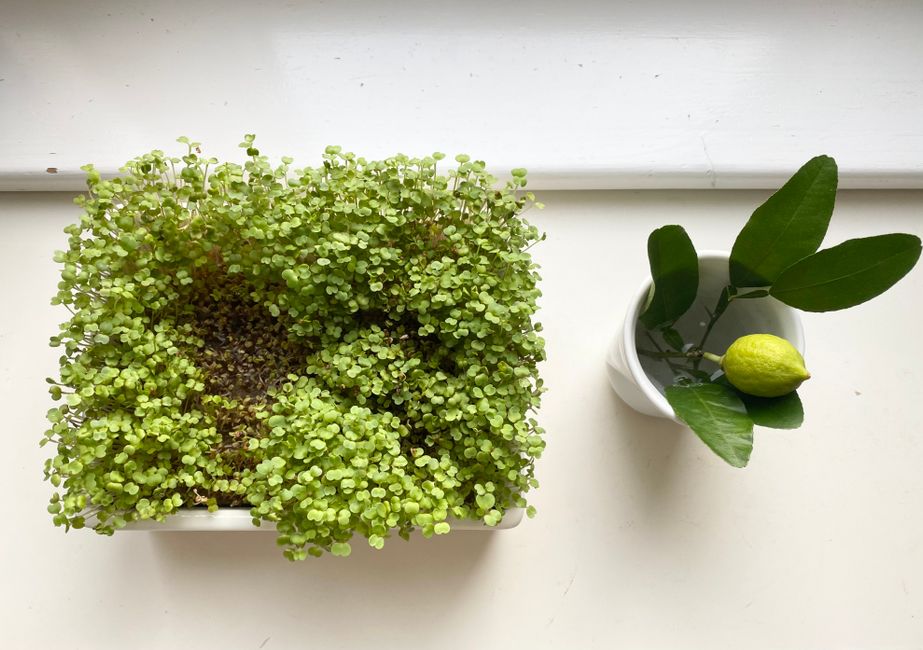
How to Grow Microgreens Indoors (UK Beginner's Guide)